

Let’s talk reality. Most businesses aren’t sellable. Not ‘difficult to sell’ – actually not sellable. Why? It is quite simple. They are owner dependent, or said differently, the value of the business is the owner. This is not bad. Our society requires people with different desires and goals to function, and so do businesses. Approximately 46.5% of private sector employees work for small businesses, and from 1995 to 2021 small businesses accounted for nearly 63% of net jobs created.
As a small business owner you should be proud, because you are large part of the life blood of this country. But, you need to be honest about what your end goal is. All businesses fit somewhere in this matrix:
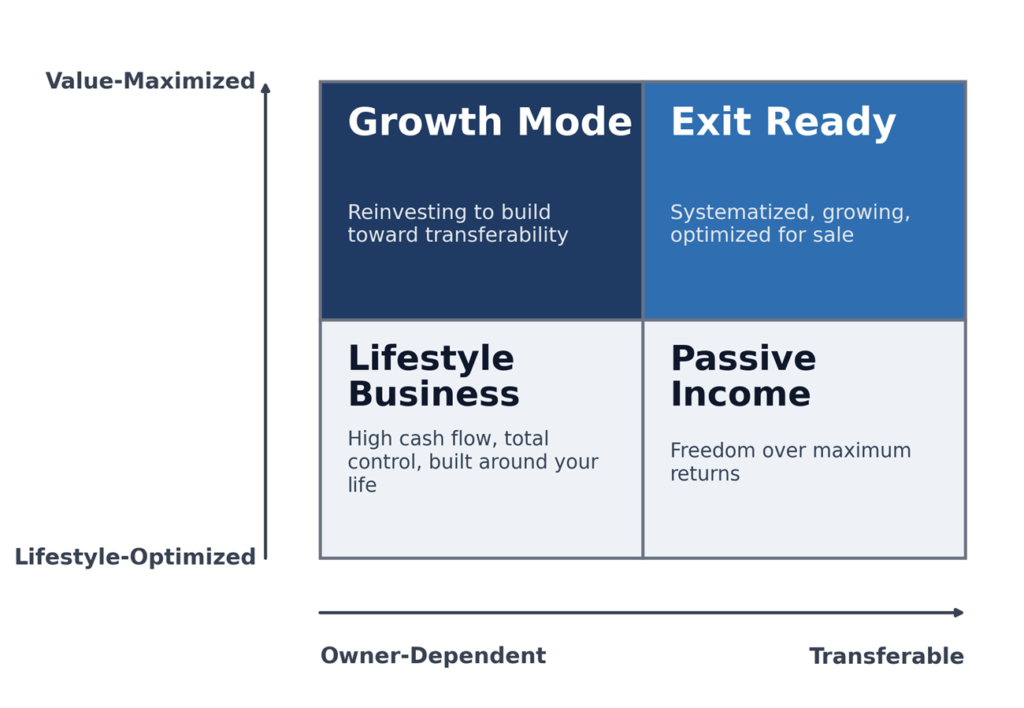
Quadrant 1: Owner-Dependent + Lifestyle-Optimized
- Definition: High cash flow, total control, built around your life
- Examples: High-end consultant billing $300/hour. Can’t hire someone else to do what you do.
- The truth: This dies when you stop, and that’s okay
Quadrant 2: Owner-Dependent + Value-Maximized
- Definition: Growth mode – reinvesting to build toward transferability
- Examples: Electrician with master’s license running 5 trucks and 12 employees. Growing revenue but can’t sell because you hold all the licenses and relationships.
- The truth: Works if you have a real plan to extract yourself. Otherwise, you’re working 70-hour weeks building equity you can’t access.
Quadrant 3: Transferable + Lifestyle-Optimized
- Definition: Passive/semi-passive income, works without you, but optimized for quality of life over maximum returns
- Examples: Three rental properties with property management company. Generates $40K/year passive. You could buy more but choose not to.
- The truth: You’ve made deliberate tradeoffs – lower returns for freedom
Quadrant 4: Transferable + Value-Maximized
- Definition: The “ideal” – systematized, growing, doesn’t need you, optimized for exit value
- Examples: Manufacturing company with COO, sales team, documented processes. You show up once a week for strategic meetings.
- The truth: Requires right operator, right market timing, often luck
Here are the questions you should be asking yourself:
- Where are you?
- Where do you want to be?
- Why?
Now, STOP! Be honest with yourself. Here is the reality…
Lower left (Consulting): “I’ll systematize this eventually and make it sellable” – No you won’t, and trying to is probably destroying what makes it work.
Lower right (Rental properties): “I should be more aggressive about expansion” – Maybe, but you chose this for a reason. Own it or change it.
Upper left (Trades with master’s license): “Just a few more years of growth and then I’ll hire someone to replace me” – You’ve been saying this for 5 years. The business design prevents your exit.
Upper right (Semi-absentee manufacturing): These owners usually aren’t lying to themselves – they know what they have. The self-deception here is more about timing – “I’ll sell when the multiple is higher” and never actually pulling the trigger.
The Diagnostic: How to Know Where You Actually Are
Three questions that force honesty:
- “If you disappeared for 60 days, would revenue drop more than 20%?” (tests transferability)
- “Are you extracting all profit as salary or reinvesting for growth?” (tests value vs. lifestyle optimization)
- “When you describe your business to strangers, do you talk about freedom or equity?” (reveals true intent)
Why This Matters: The Cost of Self-Deception
- Quadrant 2 owners burning out chasing an exit that won’t happen
- Quadrant 1 owners feeling guilty about “not building something real”
- Bad strategic decisions because you’re optimizing for the wrong metric
- Can’t sell what you think you can sell, can’t enjoy what you actually have
This Isn’t Failure – It’s Reality
The reality is that it is ok to be where you are. You got here because of the reality of starting and growing a business. Business books promise magic formulas because that’s what sells books. Reality is messier. Your situation is not the same as someone else, there is too much variability.
Personally, I run a quadrant 1 business. I am a business broker, and my business is totally dependent on me. I make good money, and I control my time, and THOROUGHLY enjoy my work. I also have a quadrant 4 business. My wife runs our distribution business. Sure, I work in that business as well, but not full time. I am not confused about what I have, and that clarity lets me make better decisions. I’ve helped dozens of business owners realize they were optimizing for the wrong quadrant – and watched them make better decisions once they got honest about where they actually were.
Take time to figure out where you are, not where you wish you were. Then ask, “does this match where I want to be in life?”. If “yes”, optimize for where you are and stop worrying about something that doesn’t match your goals. If “no”, then you know what needs to change.
Most business brokers will tell you that you want to be in quadrant 4. The truth; my truth? A very small percentage of businesses actually make it to quadrant 4, and most should never try. The question is not “which quadrant is best?” The question is “which quadrant matches your goals?”
Want an honest assessment of where your business sits? Let’s talk. I won’t tell you what you want to hear – I’ll tell you what you need to know.